


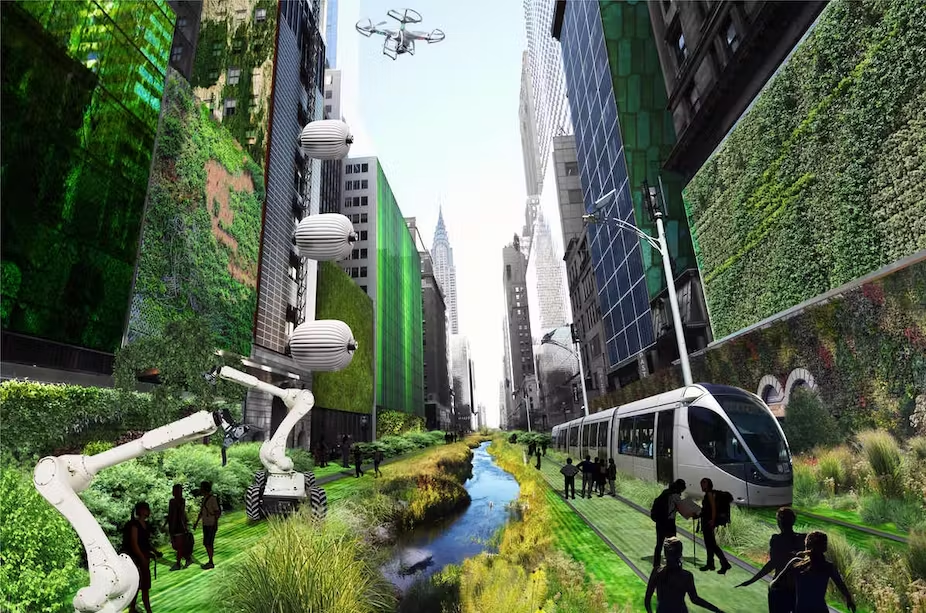
As air and water pollution in cities rises, urban populations grow exponentially larger, and fears of climate catastrophe increasingly grip people all over the planet, world leaders, politicians and city planners are turning towards designing and building better cities. But what will those future cities look like?
Although I spent many childhood years playing SimCity 4, I’m no city planner. We can look to those with more expertise in this field for ingenious ideas on how to create utopian urban sprawls in the years to come. There are certain features that should be implemented into any new development, such as carbon neutrality, effective public transport systems, and advanced technology. Planned cities in nations across the globe are already working towards incorporating these aspects into their design.
I’ll be looking at a few of these cities and exploring which features make them so innovative, efficient, and promising.
The Line, Saudi Arabia

The Line is touted as a “civilizational revolution” and judging by its concept art and the ambitions of its designers, it would certainly be unlike any other city, or even manmade structure, on Earth.
Spanning 170km in length, from the mountains of NEOM, through desert valleys, all the way to the Red Sea, The Line aims to redefine urban living. Towering 500m above sea level, with a width of 200 meters, it could completely reinvent the idea of what a city looks like.
The fully mirrored exterior walls allow the structure to blend in with the environment while reflecting the extreme light and heat of the deserts outside. Additionally, the city will run on 100% renewable energy.
The perfectly straight man-made formation will remove the need for roads, and consequentially, have zero emissions. The Line’s layout will allow for simple and accessible public transport systems to satisfy its population of 9 million people. Citizens will be able to cross the city in 20 minutes using high speed rail and reach all available amenities within a five minute walk.
The Line’s dimensions of 200m in width and 170km in length mean that the infrastructure’s footprint will be just 34 square kilometers – limiting its impact on the surrounding environment and giving residents easy access to nature.
The designers of The Line seem to have everything covered, and it’s inspiring to see a country like Saudi Arabia leading the way in environmentally-conscious construction innovation.
Telosa, United States
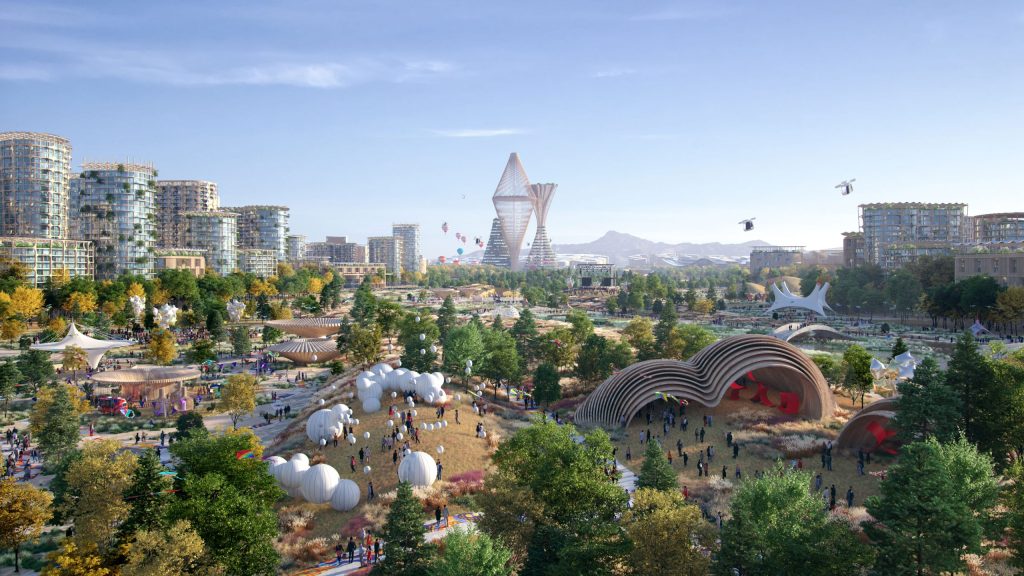
The name ‘Telosa’ is derived from the ancient Greek word meaning “highest purpose”, and one only has to read the smallest bit about this planned city to see that it’s designers and investors aim to encapsulate this higher purpose into the future city of Telosa.
Telosa’s planners intend the city to be built on cheap desert land that would be otherwise unused. Proposed locations include arid areas of Utah, Idaho, Nevada, Arizona, Texas and Appalachia.
Inclusivity and equity are at the heart of this $400 billion project proposed by American billionaire Marc Lore in 2021. With a target population of 5 million people by 2050 and a proposed area of 610 square kilometers, Telosa is being dubbed a ’15-minute city’, where all workplaces, schools and services would be accessible within a fifteen minute journey.
At the center of the metropolitan structure would be a massive skyscraper named “Equitism Tower” and would act as a “beacon for the city”. It would contain water storage, vertical farmland and a roof that converts light into energy.
Fossil fuel vehicles would not be allowed in the city, and its design would put an emphasis on walkability, cycling and autonomous electric vehicles.
Telosa’s proponents assert that its design would solve the issues of rising inequality, particularly within urban areas, creating equal opportunities for residents, and all while having no carbon footprint.
Floating City, Maldives
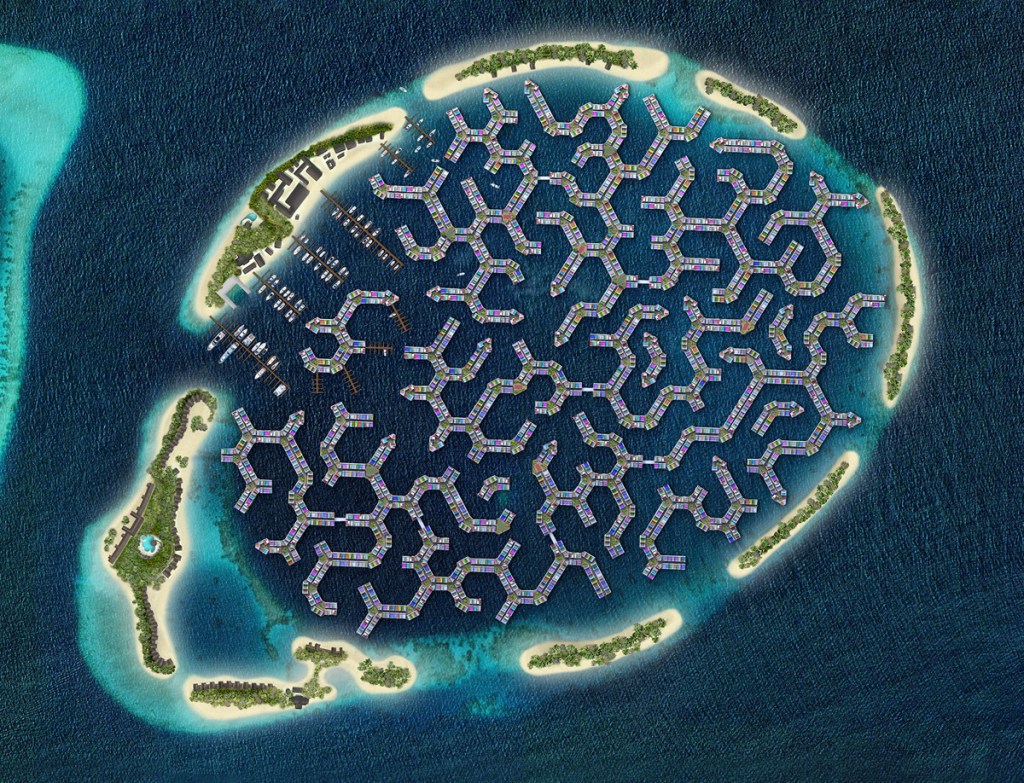
This unique and symbiotic city design aims to maintain the culture of the Maldivian people by bringing them back to the sea. As an archipelagic state, the Maldives has a strong connection to the ocean, and the world’s first floating city aims to preserve that.
Faced with rising sea levels, the world’s lowest-lying nation wants to build a car-free, eco-friendly buoyant city, structurally based on the formation of natural brain corals. Residents living in one of the 5000 proposed housing developments would traverse the city by canal, or on foot/electric scooter/bicycle/buggy using white sand roads.
The whole floating structure would be tethered to the floor of a 500-acre lagoon 15 minutes boat ride away from capital city Male and the international airport. The city would also include hotels, shops restaurants. Although the city is focused on tourism, international travelers will be able to obtain a residence permit with the purchase of a house.
Rising sea level projections for the next century and local environmental harmony were all taken into consideration while designing this ambitious concept. Governments around the world are looking at floating cities as a sustainable solution to the issue of climate change, so the Maldives floating city project could lead the charge in the emergence of this new type of urban living.
These are just a few of the many incredible cities that have been proposed and are currently in development. Although humanity should be aiming to curb climate change as much as possible, it’s also important to design cities that would survive a worst-case scenario. Cities that are impervious to climate, that can rise above rising sea levels, and can turn uninhabitable desert lands into functioning centers of technology, are going to become more common place over the next few centuries.
Personally, I can’t wait to see these architecturally innovative structures appear across the world. I hope that rather than witness societal collapse due to worsening environmental conditions, we instead see humanity’s infinite inventiveness and ingenuity giving birth to increasingly wonderous and awe-inspiring creations.
 Jason Law
Leave a comment